Publié dans un magazine international
Thursday, September 17, 2026
Depuis quelque temps, je vois régulièrement apparaître dans les biographies de photographes une formule devenue presque statutaire : « photographe publié dans plusieurs magazines internationaux ».
La formule impressionne parce qu’elle évoque spontanément une rédaction, un directeur artistique, une sélection exigeante, voire une commande, autrement dit ce que l’on associe généralement à la photographie éditoriale.
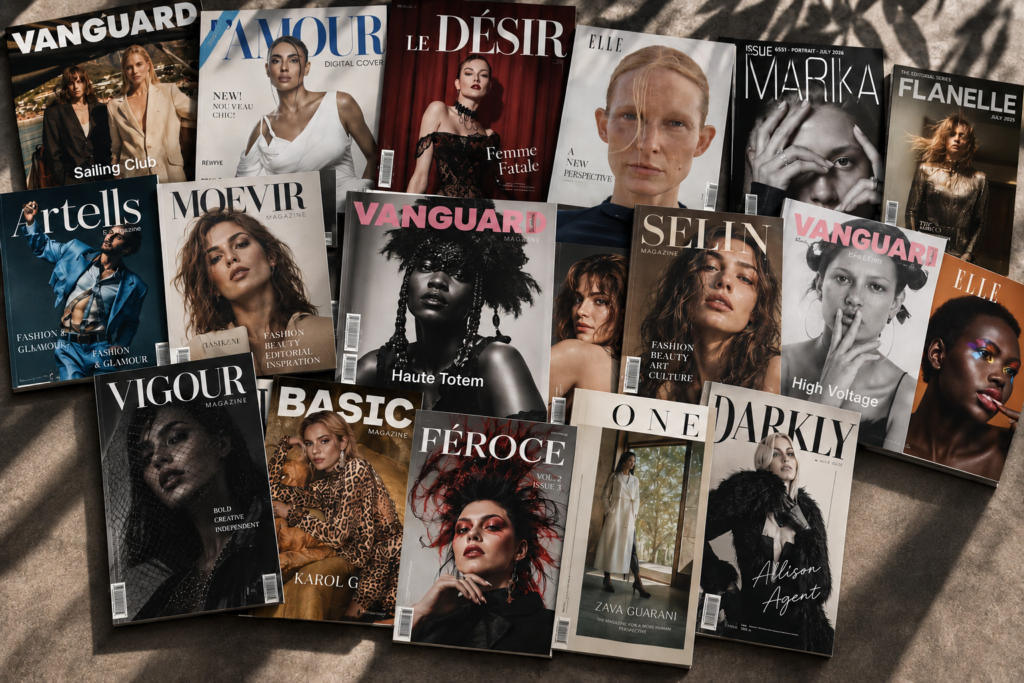
Pourtant, lorsque l’on regarde les titres concernés, on retrouve souvent les mêmes noms : Selin Magazine, Moevir Magazine, Malvie Magazine, Vigour Magazine, Beautica Magazine, Edith Magazine, Vous Magazine, Posh Magazine, Via Donna Magazine, Vionne Magazine etc …
Une partie de cet écosystème repose sur un modèle très particulier généralement qualifié sous le nom de vanity publishing.
Quand les rôles s’inversent
Dans un fonctionnement éditorial classique, un magazine a besoin d’images pour fabriquer le produit qu’il propose à ses lecteurs. Lorsqu’il souhaite réaliser un sujet photographique, il peut engager un photographe, lui commander une production, participer à son organisation et le rémunérer pour son travail et pour l’utilisation de ses photographies.
La réalité professionnelle est évidemment plus nuancée. Tous les éditoriaux ne sont pas rémunérés et certaines collaborations sont réalisées gratuitement, notamment pour développer un portfolio. Les échanges entre photographes, modèles, agences, stylistes et rédactions ont toujours existé.
Avec certains vanity magazines, la logique est différente. Le photographe organise lui-même son shooting. Il trouve la modèle, mobilise éventuellement une maquilleuse, une coiffeuse ou une styliste, fournit son matériel, son studio ou son lieu de prise de vue, consacre son temps à la préparation et à la réalisation des photographies, puis effectue la sélection et la retouche.
Il produit finalement une série complète, prête à publier, et l’envoie gratuitement au magazine.
Le magazine n’a financé ni le shooting, ni le photographe, ni la modèle, ni l’équipe ayant participé à la production. Il reçoit pourtant un contenu terminé avec lequel il peut fabriquer sa publication.
Une telle collaboration pourrait avoir un intérêt si elle était compensée par une diffusion importante, une véritable reconnaissance éditoriale ou une autre contrepartie significative. C’est précisément cette contrepartie qu’il faut examiner.
Travailler gratuitement et fournir également les droits
Un autre aspect est rarement mis en avant lorsque l’on annonce une nouvelle « publication internationale » : les droits accordés sur les photographies.
Le cas d’Artells est particulièrement intéressant. Le photographe conserve son copyright, ce qui est une distinction essentielle, mais le contrat prévoit une licence non exclusive, mondiale, perpétuelle et sans royalties. Elle couvre notamment la reproduction, la publication, l’affichage, le recadrage, la retouche et la modification des contenus, ainsi que leur utilisation dans les publications imprimées et numériques, les sites Internet, les réseaux sociaux et différents supports publicitaires, promotionnels ou commerciaux de l’éditeur.
Le photographe reste donc propriétaire de ses photographies, mais autorise quelqu’un qui ne l’a pas rémunéré à les exploiter très largement, dans le monde entier, sans limitation de durée et sans royalties.
Le contrat Artells peut être consulté directement ici.
Les conditions que j’ai consultées pour Selin permettent également une utilisation large des images acceptées dans ses publications, sur ses sites, dans des vidéos, dans le marketing et la publicité, ainsi que dans différents supports participant à la diffusion et à la monétisation du magazine.
Je comprends parfaitement qu’un magazine demande l’autorisation de reproduire les photographies qu’il publie et de promouvoir le numéro dans lequel elles apparaissent. C’est normal et nécessaire.
Il existe cependant une différence considérable entre une autorisation de publication correspondant à un usage clairement identifié et une licence mondiale, gratuite, perpétuelle et couvrant des usages promotionnels, publicitaires ou commerciaux.
Une photographie est une création et son exploitation possède une valeur. Je trouve donc difficilement justifiable de fournir gratuitement un travail tout en accordant des droits très étendus à celui qui le reçoit, simplement en échange d’une publication.
Lorsque la reconnaissance devient une prestation
Autour des soumissions gratuites apparaissent souvent différentes prestations payantes : traitement prioritaire, publication garantie, interview, publication sur Instagram, pages supplémentaires, couverture ou exemplaire numérique et papier.
Chez Moevir, certaines offres proposent explicitement une publication garantie ou annoncent une probabilité d’acceptation de 100 %, avec des tarifs pouvant atteindre plusieurs centaines de dollars selon la prestation choisie. Artells commercialise également différentes formes de visibilité, jusqu’à des offres comprenant couverture, interview, publication numérique et promotion sur les réseaux sociaux.
Cela ne signifie évidemment pas que toute photographie publiée par ces magazines a été achetée. Certains proposent également de véritables soumissions gratuites et conservent une forme de sélection éditoriale. De même, la présence d’un magazine sur une plateforme comme Kavyar ne constitue en elle-même aucun problème.
Ce qui m’intéresse ici est précisément la coexistence de ces deux logiques : une sélection éditoriale peut subsister tandis que certains attributs traditionnellement associés à cette reconnaissance deviennent parallèlement des prestations commerciales.
Une couverture, par exemple, possède normalement une valeur particulière parce qu’elle est rare et qu’une rédaction choisit parmi les images disponibles celle qui représentera son numéro. Lorsqu’elle peut également être obtenue dans le cadre d’une prestation payante, elle conserve évidemment son apparence, mais sa signification éditoriale devient beaucoup plus difficile à apprécier de l’extérieur.
Le photographe devient aussi le client
Le print on demand ajoute une autre dimension à ce modèle. Des services comme MagCloud permettent de proposer un magazine imprimé sans financer préalablement un tirage important ni organiser un véritable réseau de distribution. Un exemplaire est fabriqué lorsqu’il est commandé.
Le procédé n’a rien de critiquable en lui-même. Il permet à quantité de petits éditeurs, artistes et auteurs de produire des objets imprimés qui n’existeraient probablement pas autrement mais associé au vanity publishing, il peut cependant conduire à une situation particulière. Le photographe a fourni gratuitement le contenu, mais le magazine ne lui fournit pas nécessairement gratuitement l’exemplaire imprimé dans lequel ses photographies apparaissent. S’il souhaite le posséder, il peut donc être amené à l’acheter.
Pour une publication très confidentielle, les acheteurs les plus naturellement intéressés risquent alors d’être précisément le photographe, la modèle, les autres membres de l’équipe et leur entourage. Le contributeur devient ainsi également un client potentiel du produit qu’il a contribué à fabriquer.
Mais quelle exposition ?
C’est probablement ce qui me fait le plus douter de l’intérêt de cette mécanique.
En 2026, Instagram et les autres plateformes sociales permettent à un photographe de montrer directement son travail à des milliers de personnes. Un site personnel permet de présenter une série exactement comme on le souhaite. Une publication coordonnée entre photographe, modèle, maquilleuse et styliste permet également de réunir plusieurs audiences autour d’un même travail.
Il faut donc se demander ce qu’apporte réellement une publication dans un magazine très confidentiel, parfois produit à la demande, dont le lectorat réel est difficile à connaître.
Si la publication ne m’apporte ni rémunération, ni audience significative, ni véritable intérêt éditorial, je vois personnellement peu de raisons de lui confier mes photographies, surtout lorsque les conditions de soumission comportent des droits d’exploitation étendus. Je préfère dans ce cas publier directement mon travail et conserver la maîtrise de sa présentation et de son utilisation.
« Internationally Published Photographer »
Il subsiste toutefois une contrepartie particulièrement visible : la possibilité d’indiquer « Published Photographer » ou « Internationally Published Photographer » dans une biographie ou, sous une photo publiée sur les réseaux sociaux, une mention telle que « Cette photo a été publiée dans le magazine xxxxx ».
Ces formulations sont tout à fait exactes. Elles peuvent toutefois être interprétées, par une personne qui ne connaît pas cet univers, comme une reconnaissance du travail d’un photographe par plusieurs rédactions.
Cette reconnaissance devient plus complexe à apprécier lorsqu’un magazine fait paraître un très grand nombre de contributeurs tout en offrant, en parallèle, des publications garanties, des mises en couverture ou diverses prestations visant à mettre en valeur cette parution.
C’est sans doute ce qui se cache derrière l’expression vanity publishing. La valeur que recherche le contributeur ne tient pas forcément à l’audience du magazine, mais peut se trouver dans l’image d’une reconnaissance éditoriale qu’il pourra ensuite mettre en avant sur son site, dans son portfolio ou sur ses réseaux sociaux.
Un mot aux modèles
Cette question concerne également directement les modèles et mérite une attention particulière.
Lorsqu’un photographe vous propose de soumettre les photographies d’un shooting à un « magazine international », demandez-lui de quel magazine il s’agit, pourquoi cette publication est envisagée et sous quelles conditions votre image sera utilisée.
Une publication dans un magazine très confidentiel en print on demand ne constitue pas automatiquement une opportunité professionnelle. Rien ne permet de supposer qu’elle entraînera des contacts avec des agences, des marques ou d’autres photographes, ni même qu’elle offrira davantage de visibilité qu’une publication directe des mêmes photographies sur vos propres réseaux sociaux.
Les conditions de certaines publications peuvent en revanche dépasser largement l’autorisation d’imprimer quelques photographies dans un numéro. Le contrat d’Artells, par exemple, demande au titulaire des droits de garantir qu’il possède les autorisations nécessaires concernant les personnes reconnaissables figurant sur les photographies, tandis que les utilisations prévues par la licence ne sont pas limitées à l’impression du magazine.
Avant d’accepter une soumission, il est donc parfaitement légitime de demander au photographe de communiquer les conditions auxquelles les images seront soumises.
Cette précaution me paraît d’autant plus raisonnable que les photographies numériques peuvent désormais être copiées, modifiées et recomposées dans des processus dont les possibilités évoluent rapidement, notamment avec les outils d’intelligence artificielle.
Il faut toutefois être précis : je n’affirme pas que Selin, Artells ou les autres magazines cités utilisent les photographies soumises pour entraîner des modèles d’intelligence artificielle. Les conditions que j’ai consultées ne permettent pas de l’affirmer.
Lorsqu’on ignore ce que deviendront les technologies et les possibilités d’exploitation d’une image dans cinq, dix ou vingt ans, je vois simplement peu d’intérêt à multiplier les licences extrêmement larges ou perpétuelles lorsque la contrepartie obtenue aujourd’hui est pratiquement inexistante.
Si le plaisir recherché consiste simplement à posséder une belle photographie issue d’un shooting, il existe une solution beaucoup plus simple : en faire réaliser un véritable tirage.
Un portrait en 20 × 30, 30 × 40 ou 40 × 60 cm, sur papier photographique ou Fine Art, éventuellement encadré, permet de choisir l’image, son format, son papier et sa destination sans accorder de droits supplémentaires à un magazine dont on connaît parfois mal le lectorat et la diffusion.
En France, Picto est une référence historique du tirage photographique professionnel, avec des solutions argentiques et Fine Art. Art-photo-lab et Négatif+ proposent également des tirages photographiques, des impressions pigmentaires, des grands formats et des encadrements.
Pour les commandes en ligne, Saal Digital France propose des tirages photographiques et des impressions Fine Art sur différents papiers, notamment Hahnemühle. WhiteWall constitue également une excellente référence européenne pour les tirages et encadrements haut de gamme, même s’il s’agit d’un laboratoire allemand et non français.
À titre personnel, entre accorder très largement l’exploitation de son image pour pouvoir annoncer que l’on est « publiée » et investir quelques dizaines d’euros dans un véritable tirage d’une photographie dont on est fière, je trouve le second choix beaucoup plus intéressant.
Ce que devrait être une publication
Je n’ai rien contre les petits magazines indépendants. Une publication confidentielle peut avoir une véritable identité, une direction artistique exigeante et un lectorat passionné. Un petit fanzine réalisé par quelques personnes sincèrement investies dans leur projet peut avoir beaucoup plus de valeur artistique à mes yeux qu’un titre bénéficiant d’une diffusion considérable.
La confidentialité n’est donc pas en elle-même un problème. Ce qui me gêne est la situation dans laquelle la reconnaissance éditoriale devient un produit vendu aux personnes qui fournissent le contenu.
Si une rédaction dont j’apprécie réellement le travail souhaite publier mes photographies, j’en serai évidemment heureux. Si elle souhaite me commander un shooting et exploiter les photographies dans ses pages, nous retrouvons le fonctionnement éditorial traditionnel : un éditeur a besoin d’images et engage un photographe pour les produire.
Une publication non rémunérée peut également avoir du sens lorsque le projet artistique, la rédaction, le lectorat ou la diffusion justifient réellement la collaboration.
En revanche, produire entièrement un shooting, fournir gratuitement les photographies, ne recevoir aucune rémunération, accorder des droits d’exploitation particulièrement larges, puis éventuellement payer pour obtenir une publication garantie, une couverture ou acheter l’exemplaire contenant ses propres images ne correspond pas à ma conception de la photographie éditoriale.
Certains y trouvent leur compte et sont parfaitement libres de le faire. Pour ma part, si mon envie est de montrer mon travail, les moyens de le faire directement n’ont jamais été aussi nombreux. Si je souhaite donner une existence physique à une photographie, je préfère investir dans un beau tirage plutôt que dans l’exemplaire d’un magazine que personne autour de moi n’aurait probablement acheté si mes photographies n’y figuraient pas.
Article recommandé Recommended Article
Portrait d'une métamorphose
Comme je l'ai souvent exprimé, il m'est essentiel de plonger un peu dans l'intimité de mes modèles avant de les immortaliser. Cette approche vise à créer une connexion authentique, un lien qui transcende la simple esthétique pour toucher à l'essence même de la personne. C'est au cours de nos échanges que notre conversation a pris une tournure plus révélatrice.
Lire la suite Read morePublished in an International Magazine
For some time now, I have regularly seen a phrase appearing in photographers’ bios that has almost become a status marker: “published in several international magazines.”
It sounds impressive because it naturally brings to mind an editorial team, an art director, a demanding selection process, perhaps even an assignment. In other words, what we generally associate with editorial photography.
Yet when you look at the publications involved, the same names often come up: Selin Magazine, Artells Magazine, Moevir Magazine, Malvie Magazine, Vigour Magazine, Beautica Magazine, Edith Magazine, Vous Magazine, Posh Magazine, Via Donna Magazine, and Vionne Magazine.
Part of this ecosystem operates according to a model generally described as vanity publishing. To understand what bothers me about this system, it is worth looking first at how it works.
When the Roles Are Reversed
In a traditional editorial model, a magazine needs images to create the product it offers its readers. When it wants to produce a photographic story, it may hire a photographer, commission the shoot, participate in its organization, and pay the photographer both for the work and for the use of the photographs.
Professional reality is obviously more nuanced. Not every editorial is paid, and some collaborations are produced without compensation, particularly for portfolio development. Exchanges between photographers, models, agencies, stylists, and editorial teams have always existed.
With some vanity magazines, however, the arrangement is different. The photographer organizes the shoot, finds the model, may bring in a makeup artist, hairstylist, or stylist, provides the equipment, studio, or location, spends time preparing and producing the photographs, and then handles the selection and retouching.
The result is a complete, publication-ready series that is submitted to the magazine free of charge.
The magazine has funded neither the shoot, the photographer, the model, nor the team involved in the production. It nevertheless receives finished content from which it can create its publication.
Such an arrangement could still make sense if it were offset by substantial circulation, genuine editorial recognition, or some other meaningful benefit. That is precisely what needs to be examined.
Working for Free and Providing the Rights as Well
Another aspect receives far less attention when a new “international publication” is announced: the rights granted over the photographs.
Artells provides an interesting example. The photographer retains copyright, which is an essential distinction, but its agreement provides for a non-exclusive, worldwide, perpetual, royalty-free license. This includes reproduction, publication, display, cropping, retouching, and modification of the content, as well as its use in print and digital publications, websites, social media, and various advertising, promotional, or commercial materials produced by the publisher.
The photographer therefore remains the owner of the photographs while allowing an organization that has not paid for them to use them very broadly, worldwide, without a time limit and without royalties.
The Artells agreement can be read here.
The terms I reviewed for Selin also allow broad use of accepted images in its publications, on its websites, in videos, in marketing and advertising, and through various media involved in the promotion and monetization of the magazine.
I fully understand why a magazine needs permission to reproduce the photographs it publishes and to promote the issue in which they appear. That is both normal and necessary.
There is, however, a considerable difference between permission to publish photographs for a clearly identified purpose and a worldwide, royalty-free, perpetual license that also covers promotional, advertising, or commercial uses.
A photograph is a creative work, and the right to use it has value. I therefore find it difficult to justify providing the work for free while also granting extensive usage rights simply in exchange for publication.
When Editorial Recognition Becomes a Service
Alongside free submissions, there are often paid options: priority review, guaranteed publication, interviews, Instagram features, additional pages, covers, and digital or print copies.
At Moevir, some submission packages explicitly offer guaranteed publication or advertise a 100 percent acceptance rate, with prices that can reach several hundred dollars depending on the option selected. Artells also sells various forms of visibility, including packages that can include a cover, an interview, digital publication, and social media promotion.
This does not mean, of course, that every photograph published by these magazines has been paid for. Some also accept genuine free submissions and retain a degree of editorial selection. Likewise, the mere fact that a magazine uses a platform such as Kavyar is not a problem in itself.
What interests me is the coexistence of these two approaches: editorial selection may continue to exist while some of the attributes traditionally associated with that recognition are also sold as commercial services.
A cover, for example, traditionally carries particular significance because it is scarce and because an editorial team selects the image that will represent an issue. When a cover can also be obtained as part of a paid package, it may look exactly the same, but its editorial significance becomes much harder for an outside observer to assess.
The Photographer Also Becomes the Customer
Print on demand adds another dimension to this model. Services such as MagCloud make it possible to offer a printed magazine without financing a large print run in advance or organizing a conventional distribution network. A copy is produced when someone orders it.
There is nothing inherently wrong with the process. It allows many small publishers, artists, and authors to produce printed objects that might otherwise never exist.
Combined with vanity publishing, however, it can create an unusual situation. The photographer has provided the content for free, yet the magazine does not necessarily provide a complimentary printed copy containing that work. If the photographer wants one, they may have to buy it.
For a very small publication, the people most naturally interested in buying that issue may be the photographer, the model, the other members of the team, and their friends and families. The contributor therefore also becomes a potential customer for the product they helped create.
But What Exposure Does It Actually Provide?
This is probably what makes me question the value of the whole arrangement most.
In 2026, Instagram and other social platforms allow photographers to show their work directly to thousands of people. A personal website allows a series to be presented exactly as intended. Coordinated posts by the photographer, model, makeup artist, and stylist can also bring several audiences together around the same work.
It is therefore reasonable to ask what a publication in a very small magazine, sometimes produced on demand and with a readership that is difficult to determine, actually provides.
If a publication brings me neither compensation, a meaningful audience, nor genuine editorial value, I personally see little reason to give it my photographs, particularly when the submission terms include extensive usage rights. In that situation, I would rather publish the work myself and retain control over its presentation and use.
“Internationally Published Photographer”
There is, however, one very visible benefit: the ability to write “Published Photographer” or “Internationally Published Photographer” in a bio.
The statement may be entirely accurate. Someone unfamiliar with this ecosystem, however, may understandably interpret it as meaning that the photographer’s work has been recognized and selected by several independent editorial teams.
That recognition becomes more difficult to evaluate when a magazine publishes a very large number of contributors while also offering guaranteed publication, covers, or other paid services associated with that publication.
This is probably why the term vanity publishing is appropriate. The value sought by the contributor is not necessarily the magazine’s readership. It may instead lie in the appearance of editorial recognition that can subsequently be displayed on a website, portfolio, or social media profile.
A Word to Models
There is another aspect of this subject that directly concerns models and deserves particular attention.
When a photographer proposes submitting photographs from a shoot to an “international magazine,” ask which magazine, why the submission is being considered, and under what terms your image will be used.
Publication in a very small print-on-demand magazine is not automatically a professional opportunity. There is no reason to assume that it will lead to contacts with agencies, brands, or other photographers, or even that it will provide more exposure than publishing the same photographs directly through your own social media channels.
The terms imposed by some publications may extend well beyond permission to print a few photographs in a particular issue. The Artells agreement, for example, requires the rights holder to warrant that the necessary permissions have been obtained for recognizable people appearing in the photographs, while the uses covered by the license are not limited to printing the magazine.
Before agreeing to a submission, it is therefore entirely reasonable to ask the photographer to provide the terms under which the images will be submitted.
This seems particularly sensible today because digital photographs can be copied, modified, and recombined through processes whose capabilities are evolving rapidly, especially with the development of artificial intelligence tools.
It is important to be precise here. I am not claiming that Selin, Artells, or the other magazines mentioned in this article use submitted photographs to train AI models. The terms I reviewed do not provide a basis for making that claim.
My concern is simply that we do not know how image-processing technologies and potential forms of exploitation will evolve over the next five, ten, or twenty years. I therefore see little reason to grant extremely broad or perpetual licenses when the benefit received today is minimal.
If the real pleasure is simply having a beautiful photograph from a shoot in physical form, there is a much simpler option: have it properly printed.
A 20 × 30, 30 × 40, or 40 × 60 cm portrait on photographic or fine art paper, perhaps framed, allows you to choose the image, format, paper, and final presentation without granting additional rights to a magazine whose readership and circulation may be difficult to assess.
In France, Picto has a long-standing reputation for professional photographic printing, including traditional photographic and fine art options. Négatif+ also offers photographic prints, pigment printing, large formats, and framing.
For online orders, Saal Digital France offers photographic and fine art prints on a range of papers, including Hahnemühle. WhiteWall is another excellent European option for high-end printing and framing, although it is a German rather than a French lab.
Personally, given the choice between granting very broad rights to my image in order to say that I have been “published” and spending a few dozen euros on a proper print of a photograph I genuinely like, I find the latter far more worthwhile.
What a Publication Should Be
I have nothing against small independent magazines. A publication with a limited readership can have a genuine identity, a demanding artistic direction, and a passionate audience. A small zine created by a handful of people who truly care about what they are doing can have far more artistic value, in my view, than a publication with much wider circulation.
Being small is therefore not the issue. What bothers me is a situation in which editorial recognition itself becomes a product sold to the people supplying the content.
If an editorial team whose work I genuinely appreciate wants to publish my photographs, I will obviously be pleased. If it wants to commission a shoot and use the photographs in its pages, we are back to the traditional editorial relationship: a publisher needs images and hires a photographer to produce them.
An unpaid publication can also make perfect sense when the artistic project, the editorial team, the readership, or the circulation genuinely justifies the collaboration.
Producing an entire shoot, providing the photographs for free, receiving no compensation, granting particularly broad usage rights, and then potentially paying for guaranteed publication, a cover, or the copy containing your own photographs does not correspond to my idea of editorial photography.
Some people find value in that system and are perfectly free to participate in it. For my part, if I simply want to show my work, there have never been more ways to do so directly. If I want to give a photograph a physical existence, I would rather invest in a beautiful print than in a copy of a magazine that nobody around me would probably have bought if my photographs were not in it.