Le calendrier du 29 août
Friday, October 16, 2026
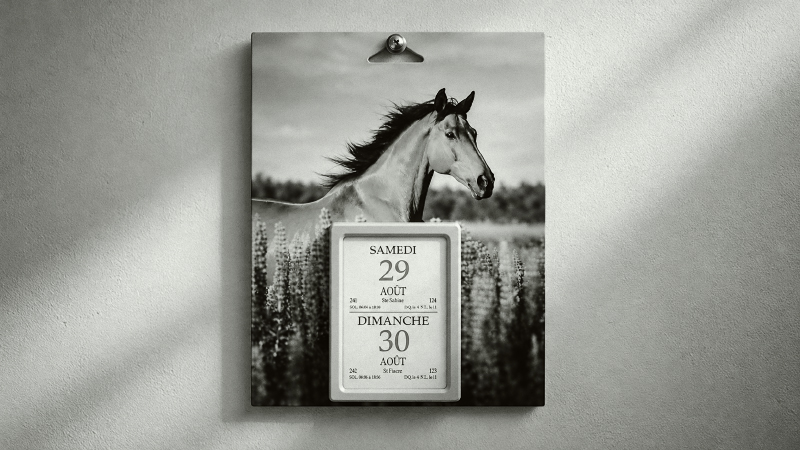
Il est toujours là, accroché au mur, à la même place. Un petit calendrier perpétuel, sur fond de cheval et de fleurs, de ceux auxquels on ne prête généralement aucune attention tant ils font partie du décor familier d’une maison. Il indique toujours le samedi 29 et le dimanche 30 août, et je me surprends aujourd’hui à penser qu’il est probablement le dernier objet que ma mère a touché avant de quitter sa maison. Je l’imagine changeant la date, comme elle l’avait fait tant de fois auparavant, sans avoir la moindre raison de penser qu’elle ne le ferait plus jamais.
Ce samedi 29 août, je l’ai accompagnée pour une prise de sang. Son état de fatigue nous inquiétait et nous voulions comprendre ce qui se passait. Depuis huit ans, elle combattait la maladie, un long parcours jalonné d’épreuves diverses, parfois sans rapport avec sa pathologie, dont elle était pourtant toujours parvenue à se relever. Nous avions fini par nous habituer à ces difficultés successives, sans doute parce qu’elle les avait jusque-là toutes surmontées, et nous pensions naturellement qu’il en irait de même cette fois encore. Mais les résultats, reçus dans l’après-midi, étaient catastrophiques et imposaient une prise en charge immédiate. Elle est partie aux urgences ce jour-là et n’est jamais revenue chez elle.
C’est cela qui m’attriste aujourd’hui bien davantage que sa mort elle-même. Je peux comprendre, et peut-être même accepter, que la mort l’ait finalement délivrée d’une maladie contre laquelle elle avait lutté si longtemps. Mais penser qu’elle n’a jamais pu retrouver cette maison qu’elle aimait tant, ses affaires, ses habitudes, tout ce qui lui était familier, m’est beaucoup plus difficile. Elle l’a quittée pour se faire soigner, probablement convaincue, comme nous l’étions encore, qu’elle finirait par y revenir.
Aujourd’hui, lorsque je retourne dans cette maison, tout est encore là. Ses meubles, ses objets, les petites choses auxquelles elle tenait et celles dont je ne connais même pas l’histoire. Et puis il y a ce calendrier, resté sur ces deux journées d’août, qui me bouleverse chaque fois que je le regarde. Il me ramène à ce samedi matin où nous étions simplement préoccupés par sa fatigue, sans imaginer un instant que cette journée serait la dernière qu’elle passerait chez elle.
Il faudra pourtant, un jour, vider les pièces, déplacer les meubles, ranger les objets et prendre des décisions qui me semblent encore difficiles à envisager. Je sais déjà que ce petit calendrier, auquel je n’avais jamais accordé la moindre importance, sera probablement l’un des objets les plus difficiles à décrocher.
Ma mère est morte le 26 septembre, presque un mois après avoir quitté sa maison. Je sais qu’elle ne souffre plus et, après ces huit années de combat, cette pensée m’apporte un certain apaisement. Mais lorsque je regarde ce calendrier, je ne pense pas vraiment à sa mort. Je pense à ce samedi matin où elle était encore chez elle, à cette journée qui avait commencé comme tant d’autres, et à ce départ dont personne, pas même elle sans doute, ne pouvait imaginer qu’il serait définitif.
The Calendar from August 29
It’s still there, hanging on the wall, in exactly the same place. A small perpetual calendar featuring a horse surrounded by flowers, the kind of everyday object you barely notice because it has always been part of a home’s familiar surroundings. It still shows Saturday, August 29, and Sunday, August 30, and I find myself thinking that it was probably the last thing my mother touched before leaving her home. I picture her changing the date, as she had done so many times before, with no reason whatsoever to imagine that she would never do it again.
That Saturday, August 29, I accompanied her for a blood test. We were concerned about how exhausted she had become and wanted to understand what was happening. She had been fighting her illness for eight years, a long journey marked by various hardships, some entirely unrelated to her condition, from which she had always managed to recover. We had grown accustomed to these successive challenges, perhaps because she had overcome every one of them until then, and we naturally believed that this time would be no different. But the results, which arrived that afternoon, were devastating and required immediate medical attention. She was taken to the emergency room that day and never returned home.
That is what saddens me today, far more than her death itself. I can understand, and perhaps even accept, that death ultimately freed her from an illness she had fought for so long. What I find much harder to come to terms with is the thought that she never got to return to the home she loved so much, to her belongings, her routines, and everything that was familiar to her. She left to receive medical care, probably believing, as we still did, that she would eventually come back.
Today, when I return to her house, everything is still there. Her furniture, her belongings, the little things she cherished, and others whose stories I don’t even know. And then there’s that calendar, still showing those two days in August, which brings tears to my eyes every time I look at it. It takes me back to that Saturday morning when all we were concerned about was her exhaustion, without imagining for a moment that it would be her last day at home.
And yet, one day, we’ll have to empty the rooms, move the furniture, put away her belongings, and make decisions that still seem difficult for me to contemplate. I already know that this little calendar, something I had never given a second thought to, will probably be one of the hardest things to take down.
My mother passed away on September 26, almost a month after leaving her home. I know she is no longer suffering, and after those eight years of fighting, that thought brings me some peace. But when I look at this calendar, I don’t really think about her death. I think about that Saturday morning when she was still at home, about a day that had begun like so many others, and about a departure that none of us, probably not even her, could have imagined would be her last.